The Double Hit Your Gut Takes On A Stressful Day
May 29, 2026Most of us have noticed that a stressful day can send digestion haywire. What researchers are now starting to understand is that reaching for a late-night meal when you are already running on cortisol may be making things considerably worse.
New findings presented at Digestive Disease Week 2026, the largest international gathering of gastroenterology researchers in the world, have put some numbers to a pattern many people recognise but cannot quite explain. The study, led by Dadigiri and colleagues, drew on data from 11,149 participants in the National Health and Nutrition Examination Survey and 4,157 from the American Gut Project. It is worth noting that this research was presented as a conference abstract rather than a fully peer-reviewed publication, so it should be taken as emerging evidence rather than definitive proof. Even so, the consistency of findings across two independent datasets makes it worth paying attention to.
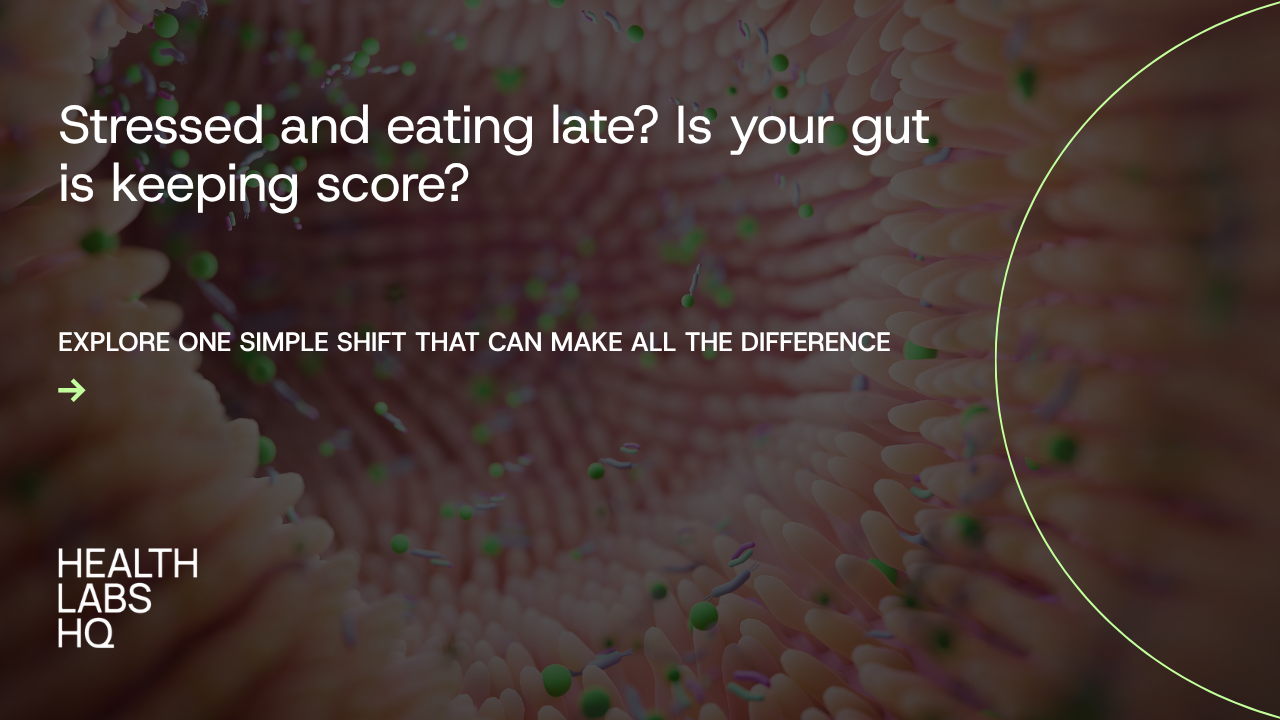
The key finding was that participants with both a high stress load and late-night eating habits showed notably higher rates of bowel dysfunction and lower gut bacteria diversity. Eating late on its own did not produce the same effect. People who only ate late showed no greater gut problems than those who did not. The combination appears to be the issue.
What might actually be happening
This research sits within a growing field called chrononutrition, the science of how your body's internal clock shapes the way it processes food. The researchers suggest that meal timing may amplify the impact of stress on the gut microbiome via the gut-brain axis, the two-way communication system involving nerves, hormones and bacteria.
When you are under sustained stress, your body carries a higher allostatic load, a cumulative measure of physiological wear that includes markers such as blood pressure, BMI and cholesterol. Your gut is already operating under pressure. Adding a significant portion of your daily calories after 9 pm may create what the researchers describe as a "double hit." Guan and colleagues (2025) found that circadian misalignment brought on by irregular eating patterns is associated with effects on gut barrier integrity and the short-chain fatty acids that beneficial bacteria produce. Voigt and colleagues (2016) have shown that the gut microbiome follows its own circadian rhythms, with bacterial composition shifting across the 24-hour cycle in alignment with feeding and activity patterns. Disrupting that rhythm through late eating may compound the stress already placed on the system.
Why this might matter for you
This is not about the occasional late dinner. It reflects a pattern that is common among working professionals: a demanding day followed by a substantial meal eaten in the evening, often as a way of decompressing. The study defined late-night eating as consuming more than 25% of daily calories after 9 pm. For anyone who eats lightly through the day and arrives home hungry at 8 or 9 pm, that threshold is easy to cross.
One practical shift to consider
Rather than overhauling your diet, the research points to one potentially meaningful change: protecting your eating window on high-stress days. A few small ways to do that:
- Eat more earlier. Front-loading your calories on demanding days, with a proper lunch and a mid-afternoon snack, means you are less likely to consume the bulk of your food after 9 pm.
- Create a natural cutoff. A consistent kitchen-closed time, even just aiming for 8 pm, gives your gut a pattern it can work with. Bishehsari and colleagues (2020) found that abnormal eating patterns cause circadian disruption with direct effects on gastrointestinal health, which suggests consistency matters more than perfection.
- Separate stress from eating. If you tend to eat as a way of unwinding, try inserting ten minutes of something else first. A short walk, fresh air, five minutes away from a screen. It is less about willpower and more about breaking a timing pattern that the research suggests may be quietly adding up.
Your gut microbiome is shaped not just by what you eat, but when you eat it and under what conditions. The evidence here is early, but the direction is clear enough to be worth considering.
References:
Bajaj, P., & Sharma, M. (2025). Chrononutrition and gut health: Exploring the relationship between meal timing and the gut microbiome. Current Nutrition Reports, 14, 79.
Bishehsari, F., Engen, P. A., Voigt, R. M., Swanson, G., Shaikh, M., Wilber, S., Naqib, A., Green, S. J., Hamaker, B., Forsyth, C. B., & Keshavarzian, A. (2020). Abnormal eating patterns cause circadian disruption and promote alcohol-associated colon carcinogenesis. Cellular and Molecular Gastroenterology and Hepatology, 9(2), 219-237.
Dadigiri, H., Venkatanarayanan, S., & Cheriyath, P. (2026). Beyond sleep alone: How stress and late-night eating disrupt bowel habits and gut microbiome diversity, a multi-cohort study. Abstract Mo1769. Presented at Digestive Disease Week 2026, Chicago, IL, 2-5 May.
Voigt, R. M., Forsyth, C. B., Green, S. J., Engen, P. A., & Keshavarzian, A. (2016). Circadian rhythm and the gut microbiome. International Review of Neurobiology, 131, 193-205.