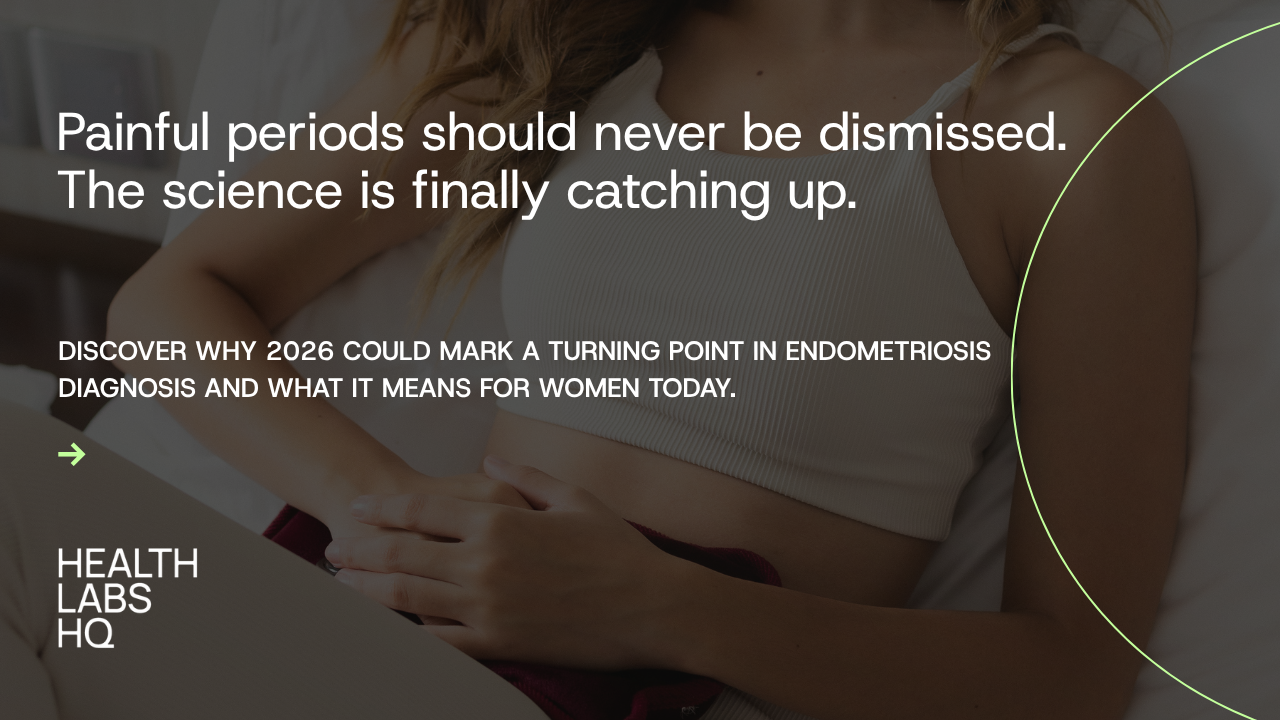
Could the eight-year wait for endometriosis finally begin to shorten?
Aug 05, 2026The average woman with endometriosis waits eight to ten years for a diagnosis. In adolescents that stretches to fourteen (Horne & Missmer, 2022). For a condition affecting roughly one in ten women of reproductive age, that delay is one of the most striking gaps in modern medicine. And there is good news gathering pace: 2026 may prove to be an important turning point, with several non-invasive diagnostic approaches moving from early research into larger clinical validation studies.
In March 2026, the Journal of Minimally Invasive Gynecology published results of a multi-centre case-control study of a new blood-based diagnostic assay. Across 298 reproductive-age women, the test integrated seven circulating biomarkers, three microRNAs, three proteins and one steroid hormone, alongside age and BMI, using machine learning. Compared with transvaginal ultrasound and MRI, the blood test picked up 61.5% of histologically confirmed endometriosis cases that the imaging modalities missed (Wong et al., 2026).
An honest note. The study's authors are employees of the company commercially developing the test, and the training sample was still relatively small. A larger, geographically diverse validation study is now underway. What this study does show is a clear proof of concept: molecular biomarkers plus machine learning can complement current imaging and detect cases current tools cannot. Although promising, the assay remains in clinical validation and is not yet part of routine NHS diagnostic pathways.
A 2024 review in Cell Reports Medicine documents parallel advances across ultrasound, MRI and hormonal management, painting a picture of a field finally moving after decades of stagnation (Saunders et al., 2024).
Why this is genuinely encouraging
For too long, women have been told painful periods are normal, or asked to wait through another six-month referral. That tide is turning. Dedicated endometriosis centres, updated clinical guidance and emerging diagnostic technologies suggest the field is moving in a more positive direction, even though substantial delays remain.
Practical takeaway: red flag symptoms worth raising
If any of these apply, they are worth raising with your GP explicitly rather than waiting to see if they pass:
- Cyclical or non-cyclical pelvic pain that interferes with daily activities
- Painful periods that do not respond to standard over-the-counter pain relief
- Pain during or after sex
- Painful bowel movements or urination during periods
- Fatigue that follows a menstrual pattern, or persistent lower back pain
- Difficulty conceiving
Ask directly: "Could this be endometriosis, and what does the current diagnostic pathway look like for me?" Being explicit may help ensure endometriosis is considered earlier in the diagnostic pathway.
Best practice for the coming month
Keep a simple symptom diary for two menstrual cycles: pain out of 10, interference with work or sleep, and where in the cycle each symptom sits. It is one of the most useful things you can bring to a GP appointment and it strengthens the case for referral. NICE guidance in the UK explicitly recommends that GPs consider endometriosis in women presenting with these symptoms, so you are asking within the current framework, not against it.
A reflection
If a friend described the same symptoms you have been quietly enduring, what would you tell her to do? The evidence, and increasingly the clinical pathway, is finally catching up. This is the year to speak up.
References:
Wong, W. H., Yu, X., Hu, X., Shen, D., Chen, L., Knudson, R. A., Gersh, E. C., Ye, L., & Bischoff, F. Z. (2026). Noninvasive blood-based detection of endometriosis can improve standard-of-care by facilitating early diagnosis and clinical management among symptomatic women. Journal of Minimally Invasive Gynecology. Advance online publication.
Horne, A. W., & Missmer, S. A. (2022). Pathophysiology, diagnosis, and management of endometriosis. BMJ, 379, e070750.
Saunders, P. T. K., Whitaker, L. H. R., & Horne, A. W. (2024). Endometriosis: Improvements and challenges in diagnosis and symptom management. Cell Reports Medicine, 5(6), 101596.