

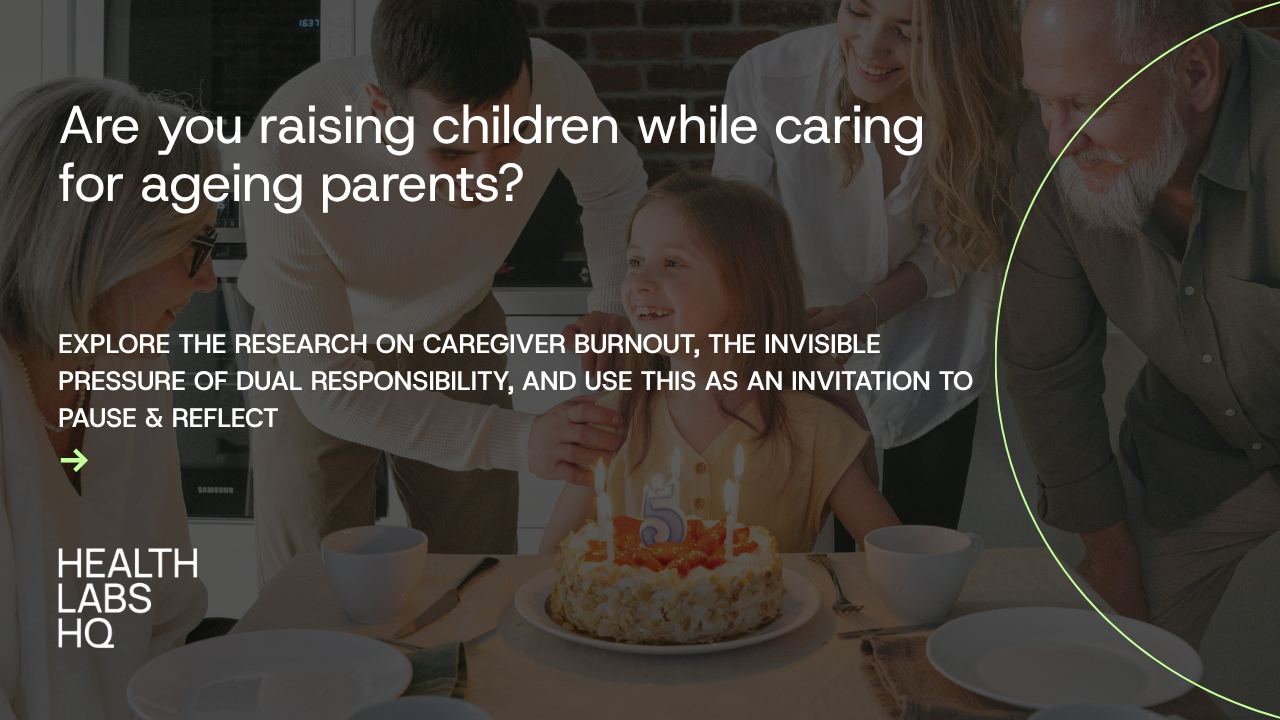
The Generation Holding Everything Together
May 04, 2026You pick up your child from school, answer a work call on the way home, then spend the evening managing your parent's care plan, medication schedule, or hospital appointment. You fall asleep doing it, wake up and do it again. Nobody gave this a warning label. Nobody told you it would feel like this. And the chances are, you have not told anyone either.
What's going on?
The sandwich generation - adults simultaneously raising children and caring for ageing parents - is not a niche demographic. Research from the Pew Research Center suggests that close to half of adults aged 40 to 59 are providing some form of care to both a parent and a child (Parker & Patten, 2013). Approximately 60% of sandwich generation caregivers are women, who on average spend significantly more time per day on caregiving tasks than their male counterparts. The financial pressure compounds the psychological one: a 2023 study found that 67% of sandwiched caregivers report difficulty balancing work and caregiving duties, with 27% shifting from full-time to part-time employment and 16% leaving work entirely for a period.
This is not simply a time management problem. Research consistently identifies this group as experiencing elevated rates of caregiver burnout - a syndrome of physical and psychological exhaustion distinct from ordinary tiredness - as well as depression, anxiety and reduced physical health outcomes (Fenstermacher et al., 2022). A large-scale study using data from over 54,000 caregivers found that younger sandwich generation caregivers - those in their thirties - were at particular risk of poor mental health, while older caregivers were more likely to experience physical health deterioration (Kim et al., 2021). The burden distributes differently across age, but it distributes across all of them.
Why is this happening?
The psychological mechanism is well understood. Chronic caregiving stress activates the HPA axis - the body's stress response system - on a near-continuous basis. There is rarely a clear off switch. Unlike acute stress, which resolves when the threat passes, caregiving stress is structurally unrelenting. There is always another appointment, another need, another decision. Research shows that the quality of relationships within the caregiving context meaningfully moderates outcomes: for sandwich generation caregivers specifically, negative relationship quality - friction, resentment, inadequate support from a partner or sibling - substantially worsens the link between caregiver burnout and depression (Lohmar et al., 2024). Support systems matter, but many caregivers find themselves providing support to everyone while receiving very little in return.
There is also an invisibility problem. Unlike physical illness or bereavement, caregiving exhaustion has no obvious external signal. You continue functioning. You continue showing up. The cost is internal, cumulative, and rarely named until it becomes a crisis.
A reflection worth sitting with
If you are part of the sandwich generation, this is not a checklist moment. It is an invitation to pause and ask yourself, honestly:
When did you last receive care, rather than give it? Not a brief rest. Not time away spent half-worrying. But genuine support that recognised what you are carrying. If the answer is difficult to find, that absence is worth noticing.
Caregiver wellbeing is the foundation that everyone else’s care rests on. You cannot pour from empty and many of you are running very close to that edge. If this resonates, consider sharing this with someone who knows you well. Not to explain yourself. Just to open a door.
References:
Fenstermacher, E., Owsiany, M., & Edelstein, B. (2022). Informal caregiving burnout among the sandwich generation. Innovation in Aging, 6(Suppl 1), 847.
Kim, H., Schulz, R., Beach, S., & Donovan, H. (2021). Examining mental and physical health status among sandwich generation caregivers. Innovation in Aging, 5(Suppl 1), 576.
Lohmar, S., Fenstermacher, E., Owsiany, M., Ju, C., & Edelstein, B. (2024). Sandwich generation caregiving: Negative relationship quality and burnout. Innovation in Aging, 8(Suppl 1), 1018.
Parker, K., & Patten, E. (2013). The sandwich generation: Rising financial burdens for middle-aged Americans. Pew Research Center.


